Customer Support | Call us on 02 4257 1105 or reach out to us via email info@morgansports.com.au
Love Your New Equipment? Leave A Product Review & Win a $100 Gift Voucher | You Will be Contacted Via DM!

Customer Support | Call us on 02 4257 1105 or reach out to us via email info@morgansports.com.au
Love Your New Equipment? Leave A Product Review & Win a $100 Gift Voucher | You Will be Contacted Via DM!


Date Posted:20 August 2026
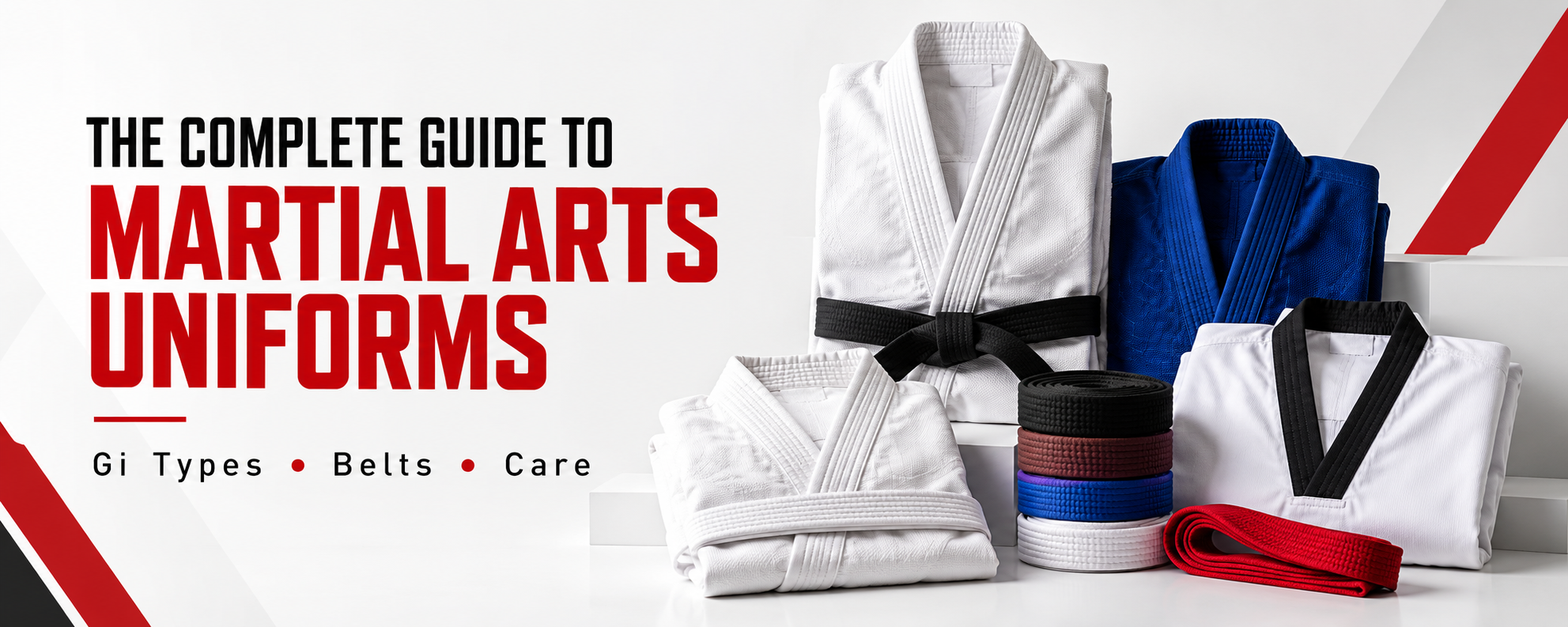
The martial arts uniform is more than a piece of clothing. It is a visual signal of your discipline, a practical tool designed to serve the specific physical demands of your art, and a marker of your place in the school hierarchy. Understanding the differences between gi types, belt systems, and care requirements saves students from wearing the wrong uniform for their art and instructors from stocking uniforms that do not serve their programme.
Morgan Sports supplies martial arts uniforms to schools, academies, clubs, and institutions across Australia. Browse the full martial arts uniform range.
|
|
|
|
|
|
|
|
|
|
|
|
|
|
|
|
|
|
|
|
|
|
|
|
|
|
|
Belt systems serve as motivation structures, progress tracking mechanisms, and communication tools within a school community. The specific colours and requirements for each grade are set by the relevant governing body or, in some cases, by individual schools where no national standard applies.
Washing
Cotton gis should be washed in cold or warm water on a gentle cycle after every training session. Damp uniforms left in a bag after training are the most common cause of mildew and fabric degradation. A gi that is washed promptly and hung to dry will last significantly longer than one left damp between sessions.
Drying
Air drying is strongly preferred over machine drying for cotton gis. Machine drying on high heat causes shrinkage (sometimes significant, particularly in heavyweight gis) and breaks down the cotton fibre structure over time. Hang in a shaded area, as direct sun can bleach white fabric unevenly and cause yellowing over time.
Storage
Gis should be folded flat and stored dry. A clean cotton gi stored correctly will maintain its structure and presentation for years. Rolling or stuffing a gi into a bag and leaving it creates permanent creases and accelerates fabric breakdown.
|
|
|
|
What is the difference between a BJJ gi and a judo gi?
Both are heavier-duty than a karate gi and designed for grappling arts. The primary differences are in the lapel thickness, skirt length, and sleeve length. BJJ gis have specific lapel thickness and sleeve length requirements under IBJJF rules, while judo gis are built for maximum durability under the gripping and throwing demands of judo. A judo gi can be used for BJJ training but may not meet competition specifications.
How do I know what size gi to order?
Gi sizing is based primarily on height rather than regular clothing size. Most manufacturers use a numbered size system (A0 to A6 for adult BJJ gis, sizes 000 to 7 for karate gis) with a size chart that maps to specific height and weight ranges. Always check the manufacturer's specific chart before ordering, as sizing conventions differ between brands.